Green Credentials: How Thoughtful Botanical Design Advances WELL Certification and Indoor Air Quality Compliance
The regulatory and certification landscape governing commercial building health has grown substantially more sophisticated over the past decade. Where facility managers once navigated a relatively straightforward set of building codes and OSHA air quality guidelines, they now contend with an expanding matrix of voluntary certification frameworks, ESG reporting obligations, and tenant-driven sustainability requirements.
Among the most consequential of these frameworks is the WELL Building Standard, administered by the International WELL Building Institute and currently applied across more than four billion square feet of real estate globally. For organizations pursuing WELL certification — or seeking to maintain competitive positioning as health-forward workplaces — botanical design is no longer a peripheral consideration. It is, when executed with precision, a meaningful compliance asset.
Understanding the WELL Standard's Relationship to Botanical Elements
The WELL Building Standard is organized around ten core concepts: Air, Water, Nourishment, Light, Movement, Thermal Comfort, Sound, Materials, Mind, and Community. Botanical design intersects most directly with the Air and Mind concepts, though its contributions extend into several additional categories when approached strategically.
Within the Air concept, WELL establishes requirements for volatile organic compound (VOC) reduction, particulate matter control, and the maintenance of acceptable CO₂ levels in occupied spaces. Research originating from NASA's landmark 1989 Clean Air Study — and substantially expanded by subsequent academic literature — has documented the capacity of certain plant species to absorb VOCs including benzene, formaldehyde, and trichloroethylene from indoor air. While the scientific community continues to debate the magnitude of this effect at typical indoor planting densities, the directional evidence is sufficiently consistent to support botanical installations as a contributing element within a broader air quality strategy.
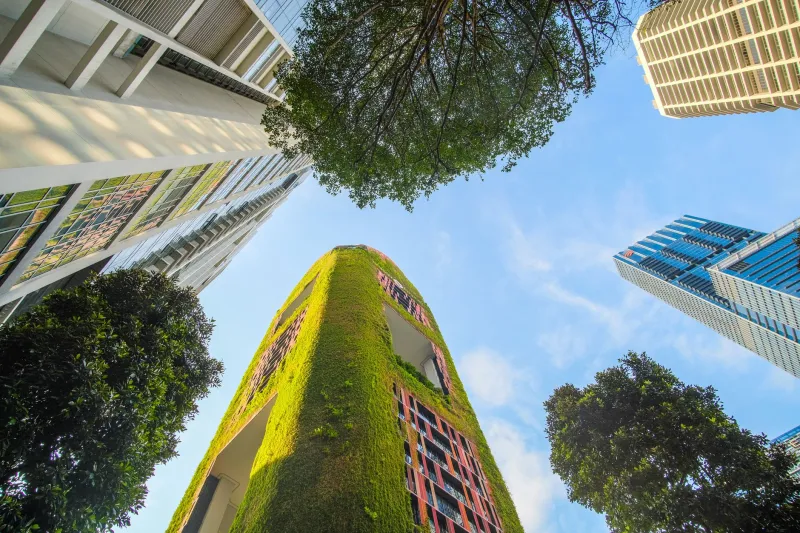
The Mind concept addresses cognitive and emotional wellbeing, encompassing factors such as restorative spaces, access to nature, and biophilic design features. Here, the case for botanical investment is considerably more direct. WELL's Feature 63, which specifically addresses biophilic design, awards points for the incorporation of living plant material, natural materials, and nature-referencing patterns into the built environment. A thoughtfully designed botanical installation — one that incorporates direct nature contact through living walls, specimen plantings, or integrated planter systems — can contribute materially to a project's Mind concept score.
The Species Selection Imperative
Not all plant selections are created equal from a compliance perspective. Facility managers and their botanical consultants must approach species selection with the same analytical rigor applied to HVAC specifications or lighting design — because the wrong plant in the wrong location produces neither aesthetic value nor measurable environmental benefit.
For air quality contribution, the species with the strongest supporting evidence include Spathiphyllum (peace lily), Chlorophytum comosum (spider plant), Sansevieria trifasciata (snake plant), Epipremnum aureum (golden Pothos), and Dracaena marginata. Each has demonstrated meaningful VOC absorption capacity in controlled settings, and each is sufficiently adaptable to the range of light and humidity conditions found in commercial interiors across the United States.
For WELL Mind concept optimization, the calculus expands to include visual impact, spatial distribution, and the variety of plant forms and textures that contribute to restorative environmental experiences. A single large specimen in a lobby contributes differently than a distributed planting strategy that introduces living material across multiple floors and functional zones. WELL assessors evaluate both the presence and the intentionality of biophilic elements — a distinction that underscores the value of working with a botanical design firm rather than a general interior decorator.
Beyond WELL: LEED, BREEAM, and Emerging State Standards
Well-informed facility managers recognize that WELL certification, while prestigious, is one component of a broader compliance and positioning landscape. LEED (Leadership in Energy and Environmental Design), administered by the U.S. Green Building Council, addresses indoor environmental quality through its EQ credit category, within which botanical elements can contribute to credits related to low-emitting materials and enhanced indoor air quality strategies.
BREEAM, the British-origin standard gaining traction among multinational real estate developers operating in US markets, similarly recognizes biophilic design within its Health and Wellbeing category. For organizations managing globally distributed real estate portfolios, botanical design strategies that are calibrated to satisfy multiple certification frameworks simultaneously represent a significant operational efficiency.
At the state level, California's Title 24 building energy code and New York City's Local Law 97 — which imposes carbon emission limits on large buildings — are creating additional pressure on facility managers to demonstrate environmental responsibility. While these regulations do not directly mandate botanical installations, organizations that can demonstrate a comprehensive, evidence-based approach to indoor environmental quality are better positioned in conversations with regulators, insurers, and sustainability-focused tenants.
Practical Implementation: What Compliance-Oriented Botanical Design Looks Like
The distinction between decorative plant placement and compliance-oriented botanical design is primarily one of documentation, density, and species precision.
A compliance-oriented installation begins with a pre-design audit that maps the space against the specific WELL features or certification credits being pursued. This audit identifies the zones where living plant material will generate the greatest point contribution, the light and HVAC conditions that will govern species selection, and the maintenance protocols necessary to sustain plant health over the certification assessment period.
Documentation is non-negotiable. WELL assessors require evidence that biophilic design features are present, maintained, and intentional. Agency Botanics provides clients with installation documentation packages that include species inventories, placement diagrams, care schedules, and photographic records — the evidentiary foundation that transforms a beautiful botanical installation into a defensible certification asset.
Planting density matters as well. Research suggests that meaningful air quality benefits require a minimum of one medium-to-large plant per approximately 100 square feet of occupied space. This threshold also aligns with the visual density thresholds that WELL's biophilic design features reference. Designing to this standard from the outset — rather than supplementing an insufficient installation after the fact — is both more cost-effective and more credible in the eyes of assessors.
The Competitive Advantage of Green Credentials
For organizations competing for premium tenants, mission-aligned employees, or ESG-conscious investment partners, WELL and LEED certifications carry real market value. A 2023 analysis by JLL found that WELL-certified buildings in major US markets commanded lease rate premiums of between six and ten percent relative to comparable uncertified properties.
Botanical design, when executed with compliance objectives in mind, is among the most cost-effective pathways to advancing certification scores. Unlike HVAC upgrades or structural modifications, a well-designed plant installation is scalable, reversible, and capable of delivering immediate aesthetic and wellness benefits while the longer-term certification process unfolds.
At Agency Botanics, we work with facility managers, sustainability directors, and real estate developers to design botanical installations that satisfy the dual mandate of visual excellence and regulatory performance. The two objectives are not in tension. In our experience, the most beautiful installations are almost invariably the most strategically sound — because the conditions that allow plants to thrive are precisely the conditions that make buildings healthier for the people inside them.