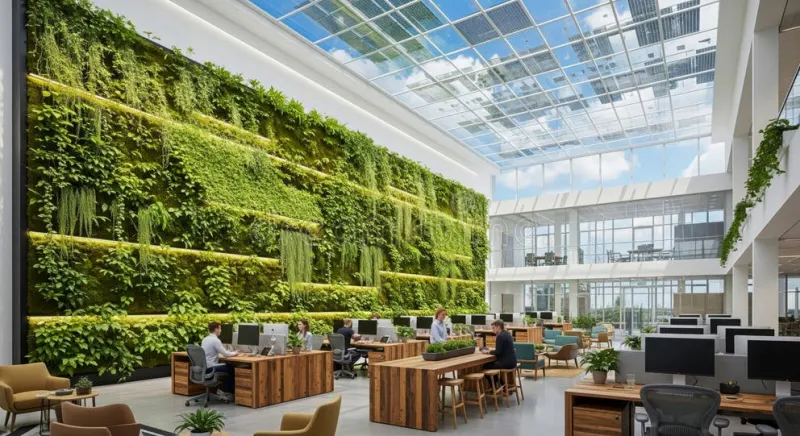
From Accessory to Architecture: How Leading Corporations Are Building Offices Around Plant Science

Photo: Tdorante10, CC BY-SA 4.0, via Wikimedia Commons
The Shift From Decoration to Infrastructure
For decades, the potted fern in the corner of a corporate lobby served one purpose: optics. It signaled a certain warmth, a gesture toward the natural world, without meaningfully engaging with it. That era is ending. Across the United States, a new generation of workplace strategists — working alongside specialized botanical agencies — is approaching plant life not as décor but as a load-bearing element of office design.
The term most frequently attached to this movement is biophilic design, a framework rooted in the hypothesis that human beings retain an innate biological affinity for natural systems. But the corporations now investing in this approach are doing so less out of philosophical conviction and more out of hard data. When plant placement, species selection, and growth patterns are aligned with how employees actually move through and inhabit a space, the outcomes extend well beyond aesthetics.
What Plant Biology Actually Tells Us About Office Layout
The science underlying biophilic office design draws from several disciplines simultaneously: botany, environmental psychology, chronobiology, and indoor air quality research. Each contributes a distinct variable to what botanical agencies now call a biophilic blueprint — a site-specific plan that treats the office as an ecosystem rather than a floor plan.
Air purification is perhaps the most immediately practical consideration. Certain species — among them pothos, peace lilies, and snake plants — have been studied for their capacity to reduce concentrations of volatile organic compounds commonly found in office environments, including formaldehyde and benzene. Rather than distributing these plants arbitrarily, botanical design professionals map air circulation patterns within a given space and position high-performing species at strategic filtration points. The result is a living ventilation layer that complements mechanical HVAC systems.
Circadian rhythm alignment represents a more nuanced application. Research has established that natural light cycles regulate human sleep-wake patterns, alertness, and mood. Botanical agencies working with major corporate clients now design greenery placements that reinforce these rhythms — positioning light-responsive species near windows to create dynamic visual cues that shift subtly across the workday, providing occupants with biological anchors that fluorescent-lit interiors typically strip away.
Growth patterns introduce a third dimension. Unlike static architectural elements, plants change. A botanical agency that understands the mature spread of a fiddle-leaf fig or the climbing behavior of a pothos vine can design installations that evolve with the space, rather than requiring periodic removal and replacement as plants outgrow their original positions.
Corporate Case Studies: When Green Becomes a Retention Strategy
The business case for this approach is no longer theoretical. Several large US-based employers across the technology, finance, and professional services sectors have documented measurable outcomes following science-backed botanical integrations.
One financial services firm headquartered in Chicago engaged a botanical agency to redesign three floors of its downtown office around a biophilic blueprint. The brief was explicit: reduce voluntary attrition, which had climbed steadily through post-pandemic return-to-office friction. The agency conducted a full environmental audit, mapped natural light availability across all three floors, and developed a species plan that introduced over 400 plants across zones calibrated for both air quality and visual rest. Within fourteen months of implementation, the firm reported a 19 percent reduction in voluntary turnover among employees occupying those floors compared to floors that had not been redesigned.
A technology company in Austin undertook a similar engagement with a different emphasis: productivity. Working with a botanical agency, the company restructured its open-plan workspace to include green corridors — pathways lined with mid-height plantings that created soft visual boundaries between collaborative zones and focus areas. Employee-reported concentration scores, measured through internal engagement surveys, rose by 23 percent over the following two quarters.
These outcomes are not coincidental. They reflect what happens when plant integration is treated as a strategic decision rather than an interior design preference.
The Agency Partnership Model
What distinguishes companies achieving these results from those that simply purchase a few large-format plants from a wholesale nursery is the nature of the expertise they engage. A qualified botanical agency brings to the table not only horticultural knowledge but also an understanding of how plant systems interact with built environments over time.
This includes ongoing stewardship. A biophilic blueprint is not a one-time installation — it is a living system that requires regular assessment, seasonal adjustment, and species rotation as conditions within the office change. Botanical agencies operating at this level function more like green infrastructure consultants than plant vendors, embedding themselves in the long-term operational planning of their corporate clients.
For businesses evaluating this model, the relevant question is not whether plants improve workplace environments — the evidence on that point is sufficiently robust. The question is whether the organization is prepared to treat botanical investment with the same strategic seriousness it applies to furniture procurement, technology infrastructure, or real estate selection.
Rethinking the Line Item
In corporate budgeting, plants have historically appeared as a miscellaneous expense — a small allocation under facilities management, renewed annually without particular scrutiny. The companies now leading in biophilic design have reclassified that line item. They are treating botanical integration as a capital investment in the physical conditions that govern employee performance and retention.
The numbers support the reclassification. When the cost of voluntary turnover — typically estimated at one-half to two times an employee's annual salary — is set against the cost of a professionally designed and maintained botanical installation, the return on investment becomes straightforward to model.
At Agency Botanics, this is precisely the conversation we bring to every corporate engagement: not what plants look good in your lobby, but what plant systems, properly designed and maintained, will deliver measurable value to your organization. The biophilic blueprint is not an aesthetic exercise. It is a business strategy grounded in biology.