Green Walls and Staying Power: How Botanical Office Design Is Winning the Talent War
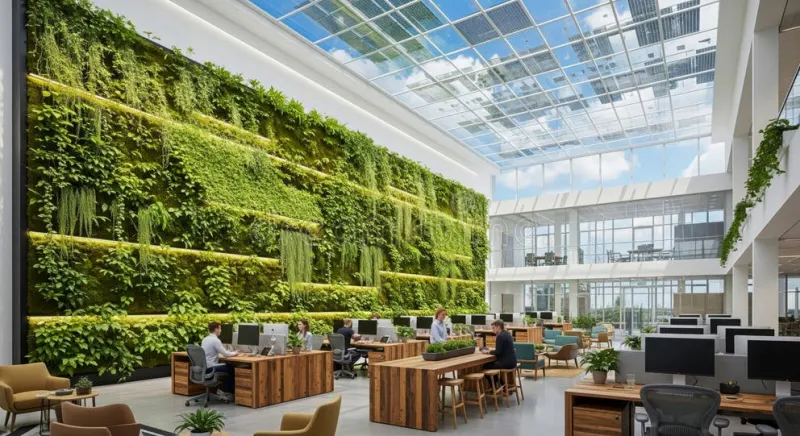
Photo: modern biophilic office design living wall plants employees working, via thumbs.dreamstime.com
The competition for skilled employees in the United States has rarely been more intense. Organizations are investing in compensation packages, flexible scheduling, and professional development programs — all legitimate strategies. Yet a quieter, more organic force is reshaping how companies attract and retain their people: the deliberate integration of living plants into the workplace environment.
This is not simply a matter of placing a potted fern in the break room. Biophilic office design — the practice of embedding natural elements, living botanical systems, and organic materials into the built environment — is emerging as a credible, data-supported lever for human resources outcomes. At Agency Botanics, we have observed this shift firsthand across corporate clients throughout the country, and the evidence warrants serious attention from any business leader responsible for workforce strategy.
What the Research Actually Shows
The connection between natural environments and human well-being is not new science. Decades of environmental psychology research support the concept that human beings respond positively — physiologically and psychologically — to exposure to living nature. What is newer is the translation of this science into measurable workplace outcomes.
A widely cited study published in the Journal of Experimental Psychology found that employees working in offices enriched with plants reported a 15 percent increase in productivity compared to those in lean, unadorned spaces. More directly relevant to retention, research conducted by the Human Spaces initiative — a global study involving over 7,600 office workers across sixteen countries — found that employees with natural elements in their workspace reported a 13 percent higher level of well-being and a 6 percent increase in overall productivity.
Perhaps most striking for HR professionals: the same study found that 58 percent of workers reported having no living plants in their workspace at all. That gap represents an untapped opportunity for differentiation.
Stress reduction is another documented benefit. Cortisol levels — a biological marker of stress — have been shown to decrease in environments with visible greenery. In high-pressure industries such as finance, legal services, and healthcare administration, this physiological effect translates directly into reduced burnout, fewer sick days, and lower voluntary turnover rates.
Case Studies: American Companies Leading the Way
Several US-based organizations have moved beyond pilot programs and made biophilic design a structural commitment.
Amazon's Spheres in Seattle remain one of the most dramatic examples of corporate botanical investment in the country. The three interconnected glass domes house more than 40,000 plants from nearly 400 species, functioning as a working environment for employees seeking an alternative to conventional office settings. Amazon has publicly attributed the space to improvements in creative collaboration and employee satisfaction scores — outcomes that support recruitment narratives across its talent pipeline.
On a more accessible scale, a regional financial services firm in Chicago undertook a phased botanical retrofit of its three-floor headquarters, working with a green design consultancy to install living walls in collaborative spaces, potted botanical arrangements in individual work areas, and a moss installation in its main reception corridor. Within eighteen months, the firm's internal engagement survey showed a statistically significant improvement in responses to questions about workplace environment and pride of place. Their HR director noted that the office redesign had become a talking point in candidate interviews — one that candidates raised unprompted.
A technology company in Austin, Texas, took a data-driven approach, tracking voluntary turnover rates before and after a botanical redesign of its open-plan office. Over a 24-month period following the installation, voluntary attrition dropped by 11 percent. The company's facilities director attributed a portion of that improvement to the redesign, alongside concurrent changes to management practices.
The Recruitment Signal That Plants Send
Beyond retention, biophilic environments function as a powerful signal during the recruitment process. Today's job candidates — particularly those in the millennial and Gen Z cohorts that now constitute the majority of the US workforce — are making employment decisions based on organizational values as much as compensation figures. A workplace that visibly invests in the natural environment communicates care: care for employee well-being, care for environmental responsibility, and care for the quality of the daily experience.
This is not a superficial perception. Research from Ambius, a workplace environment company, found that 67 percent of employees believe a well-designed workplace — including natural elements — would make them more productive, and 33 percent said they would be more likely to accept a job offer if the office environment was attractive and well-maintained.
For HR leaders managing employer brand strategy, this data suggests that botanical investment is a legitimate component of the candidate experience — one that begins the moment a prospective hire walks through the front door.
Designing for Impact, Not Aesthetics
The distinction between decorative plant placement and strategic biophilic design is significant. Random greenery scattered through an office may offer marginal aesthetic improvement, but it is unlikely to produce the retention and recruitment outcomes described above. Effective botanical workplace design requires intentionality: understanding which spaces generate the most stress, where employees spend the majority of their time, and which plant species will thrive in specific lighting and air quality conditions.
High-traffic collaborative zones benefit from larger statement installations — living walls, substantial planters, or canopy-style overhead greenery — that create a sense of immersion. Individual workstations are better served by smaller, low-maintenance species that provide a personal connection to nature without demanding employee attention. Reception and lobby areas, which form the first impression for both candidates and clients, warrant botanical arrangements that are both visually compelling and practically sustainable.
At Agency Botanics, our approach begins with an environmental audit of the space, followed by a botanical strategy that maps plant selections and placements to specific organizational goals — whether that is reducing stress in a high-pressure department, strengthening the candidate arrival experience, or improving air quality in a sealed conference environment.
A Strategic Investment, Not a Decorating Budget Line
The reframing that matters most for business leaders is this: botanical workplace design should not be categorized as a facilities or décor expenditure. When evaluated against the cost of employee turnover — which the Society for Human Resource Management estimates at between 50 and 200 percent of an employee's annual salary — an investment in living plant infrastructure is a retention strategy with a calculable return.
Companies that have made this shift are not simply creating more attractive offices. They are building environments that signal value to their people, reduce the physiological toll of demanding work, and differentiate their employer brand in a competitive labor market.
The talent war will not be won by compensation alone. The organizations that understand this — and act accordingly — are building workplaces that employees choose to stay in, season after season.