The Four-Quarter Plant Calendar: A Commercial Botanical Maintenance Guide for Every Season
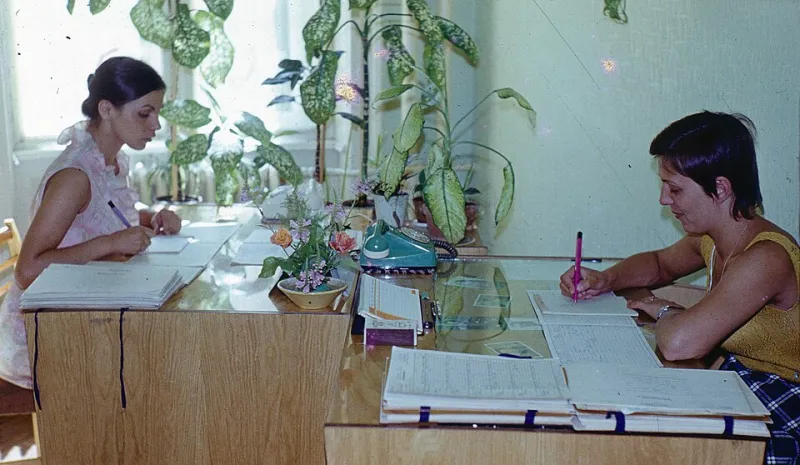
Photo: FOTO:Fortepan — ID 75663: Adományozó/Donor: Kristek Pál., CC BY-SA 3.0, via Wikimedia Commons
Why Indoor Plants Still Follow the Seasons
There is a common assumption in commercial facilities management that indoor plants, insulated from weather and climate, require uniform care year-round. It is an understandable assumption — and one that quietly accounts for the wilting, yellowing, and die-off that afflicts so many office plant installations by mid-February.
The reality is more nuanced. Even within a climate-controlled environment, commercial plants respond to the same seasonal cues that govern outdoor landscapes: the angle and duration of available natural light, the relative humidity of the surrounding air, and the subtle temperature differentials introduced by heating and cooling systems cycling through their seasonal modes. A maintenance program that ignores these variables will consistently underperform — not dramatically, but steadily, in the form of declining plant health that accumulates across quarters.
The following guide breaks down what professional seasonal plant maintenance actually looks like across the calendar year, and identifies the critical intervention points where botanical expertise makes the greatest difference.
Q1 (January – March): The Post-Holiday Recovery Protocol
January is the most consequential month in the commercial plant calendar, and the most frequently mismanaged. The combination of factors converging at this time of year is genuinely hostile to indoor plant health: natural light is at its annual low, indoor heating systems are running at full capacity and stripping humidity from the air, and many commercial spaces have just cycled through a period of reduced occupancy — and therefore reduced monitoring — over the holiday period.
The result is what botanical professionals refer to informally as the January wilt: a wave of stress responses that present as drooping foliage, soil that dries unusually fast, and leaf edges that brown and curl.
Key Q1 maintenance actions:
- Humidity assessment and correction. Central heating in US commercial buildings routinely reduces indoor relative humidity to between 20 and 30 percent during winter months. Most tropical and subtropical species — which constitute the majority of commercial office plants — prefer humidity levels between 40 and 60 percent. Botanical agencies address this through targeted humidifier placement, pebble tray systems, and strategic grouping of moisture-releasing species.
- Light compensation. With natural light reduced, plants positioned away from windows may require supplemental grow lighting during Q1. A botanical agency will audit light levels with a lux meter and recommend species repositioning or lighting additions before visible stress develops.
- Reduced watering frequency. Counterintuitively, plants in heated winter offices often need less frequent watering, not more. Slower growth rates mean slower water uptake, and overwatering during this period is a leading cause of root rot.
- Post-holiday inspection. Any plants that received reduced attention during a December closure should be assessed for soil compaction, pest activity, and root health before the new quarter is underway.
Q2 (April – June): The Reactivation Window
Spring represents the most dynamic period of the commercial plant calendar. As natural light levels climb and HVAC systems shift from heating to cooling modes, plants that have been in a slow winter state begin actively growing again. This transition, if managed correctly, produces the lush, vigorous installations that define well-maintained commercial environments.
Key Q2 maintenance actions:
- Fertilization restart. Most commercial plants should not be fertilized during winter dormancy. April marks the appropriate time to reintroduce a balanced, slow-release fertilizer schedule, calibrated to species and pot size.
- Repotting assessment. Fast-growing species that were held back by winter conditions may be ready for larger containers. Botanical agencies typically conduct a root-bound assessment in Q2 and execute repotting before summer growth peaks.
- Pest prevention sweep. Spring is prime season for fungus gnats, spider mites, and scale insects in indoor commercial environments. A proactive inspection and preventive treatment protocol in April substantially reduces the likelihood of infestations developing later in the year.
- Species rotation opportunities. Q2 is the optimal window to introduce new species or replace underperformers, as the improving light conditions give new plants the best possible establishment conditions.
Q3 (July – September): Heat, Air Conditioning, and Stress Management
Summer introduces a different category of environmental stress. While outdoor temperatures climb, commercial interiors are often pushed to the opposite extreme — aggressively air-conditioned spaces that can drop well below the thermal comfort range of many tropical species. Cold air vents positioned directly above plant installations are a particularly common source of summer stress that goes unaddressed in standard maintenance programs.
Key Q3 maintenance actions:
- Vent and draft audit. Botanical agencies will identify plants positioned in the direct path of cold air supply vents and either relocate them or introduce physical barriers. Symptoms of cold draft stress — yellowing leaves, sudden leaf drop — are frequently misdiagnosed as watering issues.
- Increased watering frequency. Unlike winter, summer air conditioning can accelerate soil moisture evaporation. Watering schedules should be revisited in July and adjusted upward for species in high-airflow zones.
- Algae and fungal monitoring. High ambient humidity in some US regions during summer, combined with indoor cooling, creates conditions favorable to surface mold and algae growth in soil and on containers. Q3 inspections should include substrate assessment.
- Window heat management. South- and west-facing windows that receive direct afternoon sun in summer can create thermal stress for plants positioned too close to the glass. Species rotation away from high-heat window positions is a standard Q3 adjustment.
Q4 (October – December): Preparing for the Difficult Months
The fourth quarter is fundamentally a preparation quarter. The decisions made in October and November determine how well a commercial plant installation will navigate the stress conditions of the following January. This is also the period during which many businesses reduce facilities attention as the holiday season approaches — a pattern that botanical agencies are specifically structured to counteract through scheduled service visits.
Key Q4 maintenance actions:
- Pre-winter fertilization taper. Fertilization should be gradually reduced through October and halted entirely by November, allowing plants to slow their growth naturally in preparation for the lower-light winter period.
- Humidity baseline establishment. Before heating systems shift to winter mode, humidity baselines should be documented so that the Q1 humidity management protocol can be calibrated precisely.
- Inventory audit. Q4 is the appropriate time to assess which species have underperformed across the year and plan replacements for Q2, avoiding the temptation to introduce new plants during the difficult winter window.
- Holiday period coverage planning. For businesses with reduced occupancy during December, a botanical agency should be engaged to schedule maintenance visits that compensate for the absence of the regular monitoring that occupant traffic provides.
The Case for Agency-Managed Seasonal Transitions
Executing these quarterly protocols consistently requires both botanical expertise and operational reliability. For most businesses, maintaining that consistency in-house — across staff transitions, busy periods, and competing facilities priorities — is not realistic. A botanical agency provides the structural continuity that seasonal plant management demands: scheduled visits, documented plant health records, and the horticultural knowledge to distinguish between a plant that needs water and one that needs a new location.
At Agency Botanics, our commercial maintenance programs are built around exactly this quarterly framework. We treat every client installation as a living system with a calendar, not a static feature with a cleaning schedule. The difference, measured in plant longevity and installation quality, is substantial.