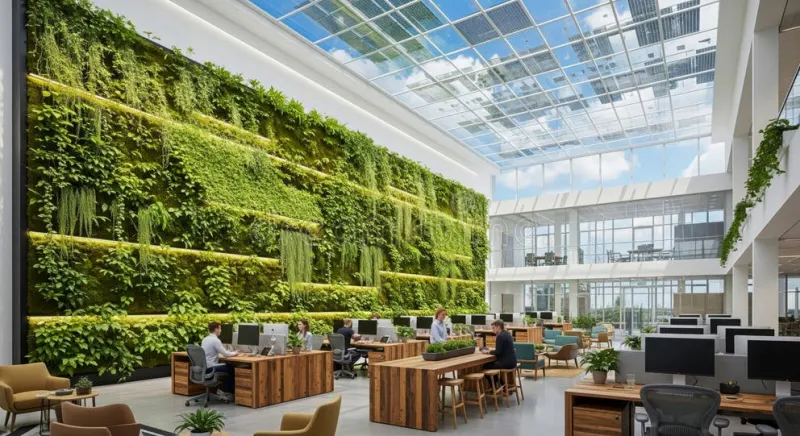
The Plant Asset Ledger: A Rigorous ROI Audit Framework for Commercial Botanical Investments
In most commercial facilities budgets, plants occupy an ambiguous category — somewhere between décor and operational expense, rarely subject to the performance scrutiny applied to other capital investments. This imprecision is costly. Organizations that lack a disciplined framework for evaluating their botanical assets routinely underinvest in high-performing species, overspend on maintenance for low-return specimens, and fail to build the institutional case for expanded green investment when the evidence would, in fact, support it.
The methodology outlined below treats commercial plants as what they functionally are: depreciating assets with measurable performance characteristics, variable maintenance costs, and quantifiable impacts on the environments — and the people — they serve. For CFOs and facilities managers seeking to bring analytical rigor to their botanical programs, this audit framework provides a starting point.
Why Standard Facilities Metrics Miss the Plant Performance Picture
Conventional facilities management metrics — cost per square foot, energy consumption, maintenance labor hours — capture infrastructure performance with reasonable precision. They were not designed, however, to account for assets whose value is partly environmental and partly psychological.
Commercial plants generate value across at least three distinct dimensions: indoor air quality improvement (a measurable environmental outcome), aesthetic contribution to workplace experience (a softer but increasingly quantifiable driver of employee retention and client perception), and acoustic modulation (an underappreciated benefit in open-plan environments). A rigorous audit must account for all three dimensions, not merely the most easily calculated one.
The following species rankings and audit methodology are designed to make that broader accounting tractable.
Species Performance Rankings: The Commercial Botanical Index
The species listed below represent the most commonly deployed options in US commercial environments. Each is evaluated across four dimensions: air-purification impact, structural durability, annualized maintenance cost (on a low/medium/high scale), and aesthetic lifespan — defined as the period during which the specimen maintains a presentation standard appropriate for professional environments without significant intervention.
1. Sansevieria (Snake Plant)
Air-purification impact: High Structural durability: Exceptional Maintenance cost: Low Aesthetic lifespan: 5–10 years with minimal intervention
The Sansevieria remains the single most defensible botanical investment for cost-conscious facilities managers. Its tolerance for low light, irregular watering schedules, and variable humidity makes it the lowest-risk species on this list. NASA's Clean Air Study identified it as an effective remover of formaldehyde and benzene — compounds commonly present in commercial interiors with synthetic furnishings. From a pure ROI standpoint, few species deliver comparable environmental performance at lower total cost of ownership.
2. Pothos (Epipremnum aureum)
Air-purification impact: High Structural durability: High Maintenance cost: Low Aesthetic lifespan: 3–7 years, with occasional pruning
Pothos is among the most forgiving species available for commercial deployment, making it particularly well-suited to environments where dedicated horticultural oversight is limited. Its trailing growth habit allows it to serve both vertical and horizontal design functions, extending its spatial utility. Air-quality research supports its classification as a high-impact purifier, with documented efficacy against carbon monoxide and xylene. Its cost-per-unit is low, and replacement cycles are infrequent under competent care.
3. ZZ Plant (Zamioculcas zamiifolia)
Air-purification impact: Moderate Structural durability: Exceptional Maintenance cost: Very low Aesthetic lifespan: 7–12 years
The ZZ Plant's extraordinary drought tolerance makes it the preferred species for facilities with inconsistent maintenance schedules. Its deep green, glossy foliage maintains a polished aesthetic over extended periods, reducing replacement frequency significantly. While its air-purification performance is moderate rather than exceptional, its durability profile and near-zero attrition rate under standard commercial conditions make it a strong contributor to long-term botanical program stability.
4. Peace Lily (Spathiphyllum)
Air-purification impact: Very high Structural durability: Moderate Maintenance cost: Medium Aesthetic lifespan: 2–4 years at presentation standard
The Peace Lily delivers among the highest air-purification returns of any commonly available commercial species, with documented efficacy against ammonia, benzene, and trichloroethylene. Its maintenance requirements are more demanding, however — it is sensitive to overwatering, drafts, and direct air conditioning exposure, and its flowering cycle requires monitoring to maintain visual presentation standards. For organizations with professional horticultural support in place, the Peace Lily represents a high-performance asset. Without that infrastructure, its risk profile increases substantially.
5. Fiddle Leaf Fig (Ficus lyrata)
Air-purification impact: Moderate Structural durability: Low–Moderate Maintenance cost: High Aesthetic lifespan: 1–3 years at presentation standard
The Fiddle Leaf Fig warrants specific attention because its aesthetic popularity in commercial interiors is frequently misaligned with its performance economics. Its sensitivity to environmental change — including light shifts, temperature fluctuation, and repotting — results in high attrition rates in standard commercial conditions and elevated replacement costs. Organizations that prioritize visual impact and have professional botanical maintenance on retainer may find its returns acceptable. Those operating without dedicated horticultural support should approach this species with caution.
The Botanical Audit Methodology
The following five-step process is designed to be executable by a facilities manager with spreadsheet access and a half-day of dedicated time.
Step 1: Inventory All Current Botanical Assets. Document every plant in your commercial environment, recording species, location, approximate age, current health status (rated on a 1–5 scale), and the date of last professional service. This baseline is the foundation of every subsequent calculation.
Step 2: Calculate Total Cost of Ownership Per Specimen. For each plant, aggregate purchase cost, cumulative maintenance expenditure, and any replacement costs incurred since initial installation. Divide by the number of months in service to produce a monthly cost-per-specimen figure.
Step 3: Assign Performance Scores. Using the species rankings above (or a customized rubric developed with your botanical consultant), assign each specimen a composite performance score across air quality, durability, and aesthetic contribution. Weight these dimensions according to your organization's priorities — a client-facing reception area will weight aesthetics more heavily than a back-office environment.
Step 4: Calculate Performance-Adjusted ROI. Divide each specimen's composite performance score by its monthly cost figure. This produces a performance-per-dollar metric that allows direct comparison across species and across locations within your facility.
Step 5: Identify Reallocation Opportunities. Specimens with low performance-adjusted ROI scores are candidates for replacement or relocation. High-scoring specimens in low-visibility locations may warrant strategic repositioning. The audit output should generate a prioritized action list, not merely a descriptive inventory.
Presenting the Case to Financial Stakeholders
The botanical audit framework described above produces data that is legible to CFOs and executive leadership because it speaks in the language of asset management rather than aesthetic preference. When botanical investments are framed as decisions with measurable environmental outcomes, defined maintenance cost structures, and quantifiable aesthetic lifespans, they become subject to the same analytical discipline as any other facilities expenditure.
Organizations that adopt this approach consistently find that the evidence supports meaningful botanical investment — not as a luxury, but as a strategically sound allocation of facilities resources with documented returns in air quality, employee experience, and spatial presentation.
The plants in your commercial environment are already performing — or failing to perform — as assets. The audit framework simply makes that performance visible.