From One Plant, Many: The Art and Science of Growing Your Collection Through Propagation
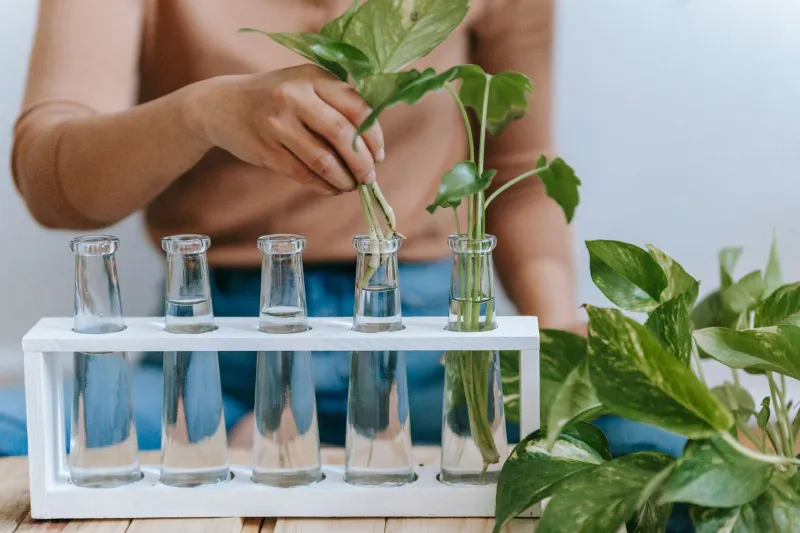
There is a particular satisfaction in placing a cutting into a glass of water on a sunny windowsill and watching, over the course of days and weeks, as a tangle of pale roots begins to emerge from the stem. It is one of the quieter pleasures available to the botanical enthusiast — and one of the most underutilized.
Propagation, in its broadest sense, is the process of producing a new plant from a parent specimen. It is as old as horticulture itself, practiced by farmers, gardeners, and botanists across every culture and climate. Yet for the modern American homeowner building out an interior plant collection, it remains something of an undiscovered practice — a technique associated with professional growers rather than the living room windowsill.
At Agency Botanics, we believe that changes the moment a client makes their first successful cutting. What begins as a practical money-saving strategy often becomes something more: a meditative practice, a form of creative patience, and a way of building genuine emotional continuity within a botanical space.
What Propagation Actually Is — and Why It Matters
At its core, plant propagation exploits a fundamental biological capacity shared by most vascular plants: the ability to generate new tissue from existing cells. Depending on the species and method employed, a gardener can produce a genetically identical new plant from a leaf, a stem segment, a root division, or even a single node.
This matters for several reasons that extend well beyond cost savings, though those savings are real. A single pothos purchased at a local nursery for twelve dollars can, within two growing seasons, yield dozens of cuttings — enough to populate an entire room or share generously with neighbors and friends. But the deeper value of propagation lies in what it does to the gardener's relationship with the plant itself.
When you have grown a monstera from a cutting taken from a plant that lived in your grandmother's kitchen, that monstera is not simply a decorative object. It is a living document of a relationship. Propagation transforms plants from purchases into legacies, and in doing so, it transforms the spaces they inhabit.
The Methods: A Practical Overview
For the home practitioner, there are three propagation methods worth mastering. Each suits different plant families and different levels of patience.
Stem Cuttings in Water
This is the most accessible entry point for beginners, and it works beautifully for a wide range of popular houseplants. The process involves taking a cutting of four to six inches from a healthy stem — ideally just below a node, which is the point on the stem from which leaves and roots emerge — removing the lower leaves, and placing the cut end in a vessel of clean, room-temperature water.
The vessel should be placed in bright, indirect light. Direct sun can encourage algae growth in the water and stress the cutting. Within one to four weeks, depending on the species and ambient temperature, roots will begin to develop. Once those roots reach approximately one to two inches in length, the cutting is ready for transfer to a well-draining potting mix.
Best candidates for water propagation: Pothos, heartleaf philodendron, tradescantia, coleus, impatiens, and most Begonia species.
Stem Cuttings in Soil
Some plants root more reliably when placed directly into a growing medium rather than water. This method requires a slightly more careful touch — the cutting must not be overwatered, as rot is the primary risk before roots establish — but it eliminates the transition stress that water-rooted cuttings sometimes experience when moved to soil.
A light, well-aerated propagation mix — typically a blend of perlite and peat or coco coir — provides the ideal environment. The cutting should be inserted one to two inches deep, the soil lightly moistened, and the entire setup placed under a clear plastic bag or humidity dome to maintain moisture while roots develop.
Best candidates for soil propagation: Rosemary, lavender, rubber tree (Ficus elastica), jade plant, and most woody-stemmed houseplants.
Leaf and Node Cuttings
Certain plants — most famously succulents and members of the Peperomia and Begonia families — can be propagated from individual leaves. A healthy, mature leaf is removed cleanly from the parent plant, allowed to callous over for a day or two, and then placed on or lightly pressed into a moist propagation medium. Over several weeks, new plantlets will emerge from the base of the leaf.
For aroids such as monsteras and philodendrons, node propagation is the relevant technique. A node cutting — a segment of stem that includes at least one node and, ideally, one aerial root — is taken and rooted in water or moist sphagnum moss. This method requires patience, as aroid cuttings can take four to eight weeks to produce meaningful root growth, but the results are consistent.
Building a Propagation Practice at Home
The physical requirements for a home propagation setup are modest. A south- or east-facing windowsill, a collection of clean glass vessels or small nursery pots, a bag of perlite, a quality all-purpose potting mix, and a pair of clean, sharp scissors or pruning shears are sufficient to begin. A dedicated propagation station — even a single shelf in a kitchen or laundry room — creates a sense of intentionality around the practice and makes it easier to maintain the consistent attention that young cuttings require.
For clients who wish to take their propagation practice further, a small grow light extends the viable propagation season through the darker winter months and dramatically expands the range of species that can be attempted. Compact LED grow light bars, now widely available from retailers such as Amazon and Home Depot, are an affordable investment that pays dividends across multiple growing seasons.
The Emotional Geometry of a Propagated Collection
Agency Botanics frequently works with clients who have been building plant collections for years before they encounter propagation. The shift that occurs when these clients begin growing their own specimens is difficult to quantify but unmistakable in practice.
One client in Portland, Oregon described it this way: she had purchased her original golden pothos as a college student, and over fifteen years, that single plant had been propagated into specimens distributed across her home, her office, and the homes of three close friends. When she moved into a new house and engaged Agency Botanics to design her living spaces, she arrived at the first consultation with a box of cuttings from the original plant — a botanical thread connecting her current life to a much earlier chapter of it.
Designing around those cuttings, and building a space that would allow the collection to continue expanding, was one of the more meaningful projects our team has undertaken. The original pothos occupied a place of honor in the finished design — not because of its rarity or visual drama, but because of what it represented.
Propagation as an Extension of Botanical Design
From a design perspective, propagation enables something that purchasing alone cannot: the gradual, organic growth of a collection that is genuinely personal. A home filled with propagated plants tells a story. It reflects the time its owner has invested, the relationships through which cuttings were exchanged, and the specific conditions — light, humidity, temperature — of the spaces in which those plants have grown.
For homeowners who are just beginning their botanical journeys, propagation offers a low-cost, low-stakes way to experiment with new species and expand their collections incrementally. For those with more established spaces, it provides a means of deepening the relationship between person and plant — of moving from curator to cultivator.
At Agency Botanics, we see propagation not as a peripheral hobby but as a natural extension of thoughtful botanical design. A home that grows its own plants is a home that is genuinely, continuously alive — and that, ultimately, is what we are always designing toward.