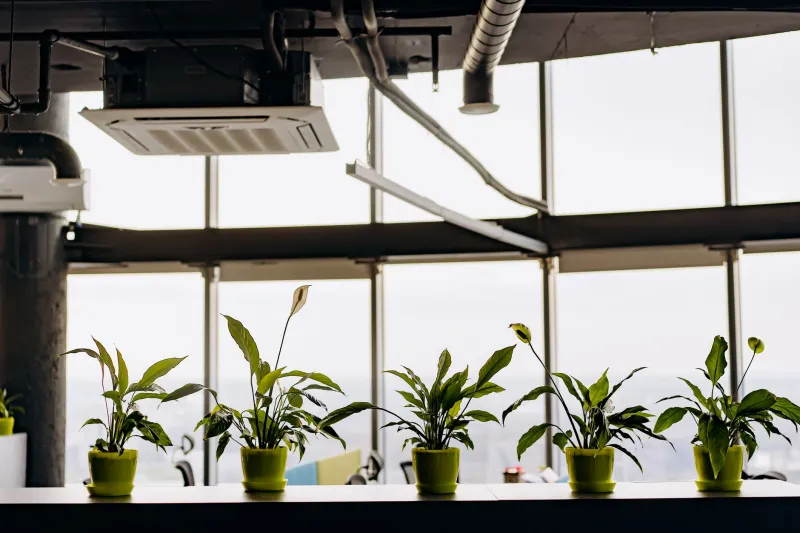
The Living Acoustic: How Plants and Green Walls Are Quietly Solving the Open-Office Noise Crisis

Walk through almost any open-plan American office between 10 a.m. and 3 p.m. and the auditory environment tells a familiar story: overlapping conversations, the percussive rhythm of mechanical keyboards, HVAC hum, and the occasional speakerphone call conducted with insufficient regard for surrounding colleagues. Noise is not a minor inconvenience in these spaces. Research consistently identifies unwanted sound as one of the primary drivers of reduced concentration, elevated stress, and declining job satisfaction among office workers.
The conventional response has been to install acoustic ceiling tiles, upholstered panels, and sound-masking systems—solutions that are effective in laboratory conditions and frequently underwhelming in practice. A different approach is gaining traction among forward-thinking facility designers: deploying living botanical systems as functional acoustic architecture. The results, when executed with precision, are both scientifically defensible and visually transformative.
Why Sound Behaves Differently Around Living Matter
Understanding why plants absorb sound requires a brief detour into basic acoustics. Sound propagates as pressure waves through air. When those waves encounter a hard, reflective surface—concrete, glass, painted drywall—they bounce back into the space, layering new sound on top of existing sound and creating the reverberant, fatiguing acoustic environments that characterize many open offices.
Soft, irregular, and porous materials behave differently. They absorb sound energy rather than reflecting it, converting acoustic pressure into negligible amounts of heat through friction within the material's structure. This is the operating principle behind acoustic foam, mineral wool panels, and upholstered furniture.
Living plants possess several of these properties simultaneously. Leaves—particularly broad, textured, or densely overlapping leaves—scatter and absorb incoming sound waves. Stems and branches introduce additional irregular surfaces that disrupt wave propagation. The growing medium itself, whether soil, moss, or a hydroponic substrate, contributes meaningful low-frequency absorption. And the air pockets within dense plantings function much like the cavities in conventional acoustic panels.
A 2015 study published in the journal Landscape and Urban Planning found that vegetation can reduce sound levels by as much as 5 to 8 decibels in controlled conditions—a reduction perceptible to the human ear and significant in the context of office acoustics, where the difference between a distracting environment and a functional one often spans fewer than 10 decibels.
Species That Work: A Practical Selection Guide
Not all plants contribute equally to acoustic performance. The variables that matter most are leaf density, surface texture, canopy volume, and the physical structure of the overall planting. The following species have demonstrated strong acoustic utility in commercial environments:
Fiddle-Leaf Fig (Ficus lyrata): Large, waxy leaves with a slightly irregular surface scatter mid-frequency sound effectively. When grouped in clusters of three or more, fiddle-leaf figs create a meaningful acoustic barrier in open-plan zones.
Rubber Plant (Ficus elastica): Dense, overlapping leaf canopies and substantial stem mass make this species one of the more acoustically efficient large-format indoor plants available. Performs well in the 500 Hz to 2,000 Hz range—the frequency band most associated with speech intelligibility and conversational distraction.
Bird of Paradise (Strelitzia reginae): The broad, paddle-shaped leaves of this species present a significant surface area for sound absorption. Its upright growth habit makes it useful as a natural partition element between workstation clusters.
Golden Pothos (Epipremnum aureum): In trailing or cascading configurations—particularly when deployed on living walls—pothos creates layered, irregular surfaces that perform well across a broad frequency range. Its density when planted in volume is the key to its acoustic contribution.
Moss Panels: Preserved or living moss walls deserve specific mention. Moss has a porous, fibrous structure that absorbs sound with particular efficiency at mid and high frequencies. Several commercial manufacturers now produce engineered moss panels rated to NRC (Noise Reduction Coefficient) values of 0.50 or higher—comparable to mid-grade acoustic foam—while also functioning as striking visual installations.
Designing for Acoustic Performance, Not Just Aesthetics
The distinction between a botanical installation that happens to reduce noise and one that is designed to reduce noise is significant. Acoustic effectiveness depends on mass, distribution, and placement—variables that require deliberate attention during the design phase.
Mass matters. A single potted plant in an open floor plate has a negligible acoustic impact. A dense cluster of six to eight large-format specimens positioned between workstation zones begins to function as a meaningful acoustic buffer. Volume is the operative principle.
Vertical coverage amplifies performance. Sound travels in three dimensions, not just horizontally. Installations that extend from floor to ceiling—living walls, tall specimen trees, vertically stacked planter systems—intercept sound at multiple heights and are substantially more effective than low-profile arrangements.
Strategic placement targets noise sources. The acoustic benefit of a botanical installation is greatest when it is positioned between a noise source and the areas requiring quiet. Locating dense plantings adjacent to collaborative zones, near phone booths, or along the boundary between open-plan desks and focused work areas addresses the problem at its origin rather than attempting to manage it diffusely across the entire floor plate.
Case Contexts: Where Botanical Acoustics Is Gaining Ground
The practical application of biophilic acoustic design is visible across several commercial contexts in the United States.
In technology sector campuses—where open-plan density is often extreme and acoustic complaints are endemic—living wall installations have been incorporated into interior design briefs as a primary noise-management strategy, supplementing rather than replacing conventional acoustic ceiling treatments. The dual benefit of acoustic performance and biophilic wellness makes the investment easier to justify to finance teams.
In financial services environments, where confidentiality and concentration are operational requirements, botanical partitions have replaced or reduced the need for full-height glass enclosures by creating semi-permeable acoustic zones that feel open while functioning as meaningful sound barriers.
In hospitality and coworking spaces, where ambient noise is a known driver of member attrition, operators have reported measurable improvements in member satisfaction scores following the installation of dense botanical zones near high-traffic circulation paths.
Integrating Botanical Acoustics into the Design Brief
For facility leaders and interior designers approaching a new project or renovation, the most productive moment to introduce botanical acoustic strategy is during the schematic design phase—before partition layouts are finalized and acoustic budgets are allocated. Incorporating living systems into the acoustic solution from the outset allows for genuine integration rather than remedial addition.
This means engaging a botanical design partner early, with a clear brief that includes both acoustic performance targets and aesthetic parameters. It means specifying plant volumes and configurations with the same rigor applied to conventional acoustic products. And it means establishing a maintenance protocol that preserves the density and health of the installation over time—because a thriving plant is an effective acoustic element, and a declining one is not.
The open office is not going away. But the noise problem it created is not inevitable. Living systems, deployed with intention and expertise, offer a path toward workplaces that are simultaneously quieter, more beautiful, and more aligned with the human need for restorative natural environments.