Grow Smart, Spend Less: A Homeowner's Framework for High-Impact Botanical Design on a Realistic Budget
Photo: Alvesgaspar, CC BY-SA 3.0, via Wikimedia Commons
There is a persistent misconception in the world of interior plant design: that truly beautiful green spaces are the exclusive province of those willing to spend generously on specimen plants, custom planters, and professional installation. At Agency Botanics, we hear this assumption regularly from first-time clients who arrive convinced that a lush, cohesive botanical interior is simply out of their financial reach.
It is not. What separates a visually compelling plant-filled room from a haphazard collection of grocery store succulents is not, primarily, money. It is strategy. This article lays out the practical frameworks we use — and that any cost-conscious homeowner or renter can apply — to achieve maximum visual return on a carefully managed botanical investment.
Start With a Design Intention, Not a Shopping List
The single most expensive mistake in amateur plant design is impulse purchasing. Walking into a garden center without a clear spatial concept leads to redundant purchases, scale mismatches, and a finished space that feels cluttered rather than curated.
Before spending a dollar, spend an hour. Walk through your home with a notebook and assess each room through three lenses: available light, dominant color palette, and the specific visual problem you want to solve. Are you trying to soften a stark, minimalist living room? Add warmth to a sterile home office? Create a sense of enclosure in an open-plan space that feels cavernous?
Design intention transforms your shopping list from a random assortment into a purposeful selection. Every plant you purchase should earn its place by serving a defined function within that intention.
Prioritize Structural Plants First
In professional botanical design, we distinguish between structural plants — those that define the bones of a space — and accent plants, which add texture, color, and detail. Budget-conscious designers should always allocate the majority of their resources to structural plants and build accent layers gradually over time.
A single large fiddle-leaf fig, bird of paradise, or monstera placed in a well-chosen corner will do more design work than twelve small plants scattered without intention. These larger specimens carry visual weight, establish scale relationships with furniture, and immediately signal that a space has been thoughtfully considered.
Yes, large specimens cost more upfront. But purchasing one well-positioned structural plant delivers more immediate impact per dollar than filling a room with small, inexpensive plants that will take years to reach meaningful size — if the conditions even support that growth.
The Strategic Case for Starter Sizes
That said, there is a compelling counter-argument for patience. Purchasing younger, smaller plants at a fraction of the mature specimen price is one of the most effective long-term budget strategies available to homeowners who plan to stay in their space for several years.
A 4-inch pothos, philodendron, or ZZ plant purchased for under ten dollars at a local nursery will, with proper care, become a substantial specimen within eighteen to twenty-four months. Buying multiple starter plants simultaneously — rather than one large specimen — also allows for greater variety and layering as the collection matures.
The practical framework: spend your larger budget allocation on one or two structural anchors purchased at a meaningful size, then build the surrounding plant layers using starter-size plants grown intentionally over time.
Where to Source Plants Without Paying Retail Premium
Garden center retail pricing reflects convenience, overhead, and often significant markup. Homeowners willing to explore alternative sourcing channels can access the same plants — sometimes superior specimens — at meaningfully lower cost.
Local plant swaps and community exchanges have grown substantially in popularity across American cities and suburbs. Platforms like Nextdoor, Facebook Marketplace, and dedicated plant swap groups on social media regularly offer healthy, mature plants at little or no cost. Propagation cuttings — rooted sections of established plants — are frequently exchanged freely between enthusiasts.
Independent nurseries and growers often price below the big-box garden center chains, particularly for common tropical and foliage varieties. Developing a relationship with a local independent nursery also opens access to end-of-season sales, imperfect plant discounts, and expert guidance that big-box staff rarely provide.
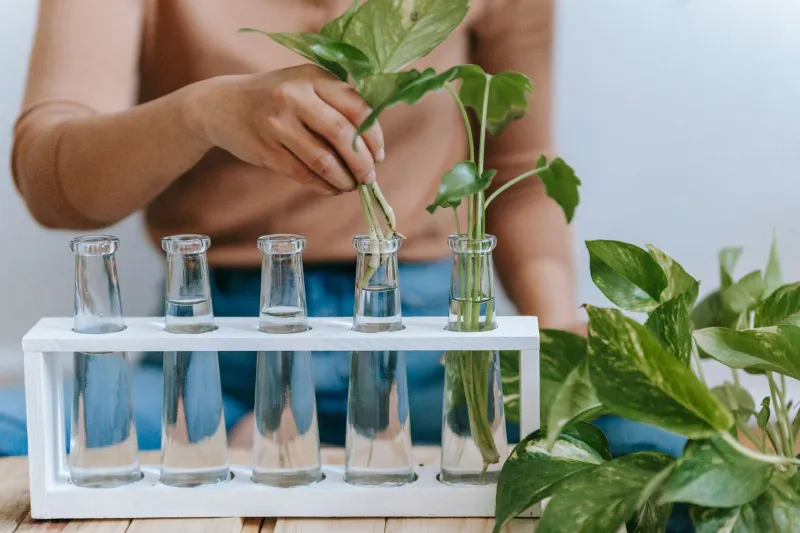
Propagation from existing plants is perhaps the most cost-effective strategy of all. Many popular interior plants — pothos, philodendrons, tradescantia, spider plants — propagate readily in water or soil from stem cuttings. If you already own any of these species, you have a free source of additional plants waiting to be activated.
Design Principles That Maximize Visual Impact
Beyond plant selection, design principles applied thoughtfully can make a modest collection look far more abundant and intentional than it actually is.
Vary elevation deliberately. Place plants at multiple heights — floor level, tabletop, shelf, and hanging — to create a sense of layered depth that draws the eye upward and outward. This vertical range makes even a small number of plants feel like an immersive environment rather than a sparse arrangement.
Cluster in odd numbers. Groupings of three or five plants read as intentional composition. Pairs and even numbers tend to feel symmetrical and static. Odd-numbered clusters at varied heights, with plants of contrasting leaf shape and texture, create visual rhythm without requiring many specimens.
Invest in containers selectively. A beautiful planter elevates a modest plant. Conversely, an inexpensive plant in a well-chosen container can look far more considered than its price suggests. Allocate container budget to the most visible positions in a room and use simpler, more affordable pots in secondary locations.
Use trailing plants to fill visual space. Trailing varieties — pothos, string of pearls, heartleaf philodendron — cover significant visual territory from a single pot. A hanging basket positioned in a corner or above a window can fill an entire quadrant of a room's visual field for a very modest investment.
Setting a Realistic Budget Framework
For a standard living room botanical refresh, a working budget of $150 to $300 is entirely sufficient when applied with strategic discipline. Allocate roughly half to one or two structural anchor plants. Reserve approximately thirty percent for accent plants and starter specimens to be grown out over time. Dedicate the remaining twenty percent to containers and any basic care supplies — a quality potting mix, drainage trays, and a reliable watering vessel.
For renters or those working with smaller spaces, these figures compress accordingly. A single well-chosen structural plant and three to four complementary accents, properly arranged, can transform a studio apartment's living area for under $100.
The investment that matters most, ultimately, is not financial. It is attentional. Plants placed with intention, cared for consistently, and selected to serve a specific design purpose will always outperform a more expensive collection assembled without a guiding concept.
At Agency Botanics, our work with residential clients consistently demonstrates that the gap between a beautiful botanical space and an ordinary one is closed by knowledge and strategy — not by budget size alone.